
Exploring the use of existing acoustic emissions as a zero-overhead telemetry source for real-time infrastructure state analysis.
The Observation
During local LLM benchmarking on a dual-Xeon Supermicro server, we noted a consistent correlation between computational load and the acoustic profile of the system. As the GPU and CPU workloads increased, the server fans entered a progressively louder state. Crucially, the acoustic signature shifted noticeably when workload characteristics changed, and the system returned to a baseline quiet state upon computation stop.
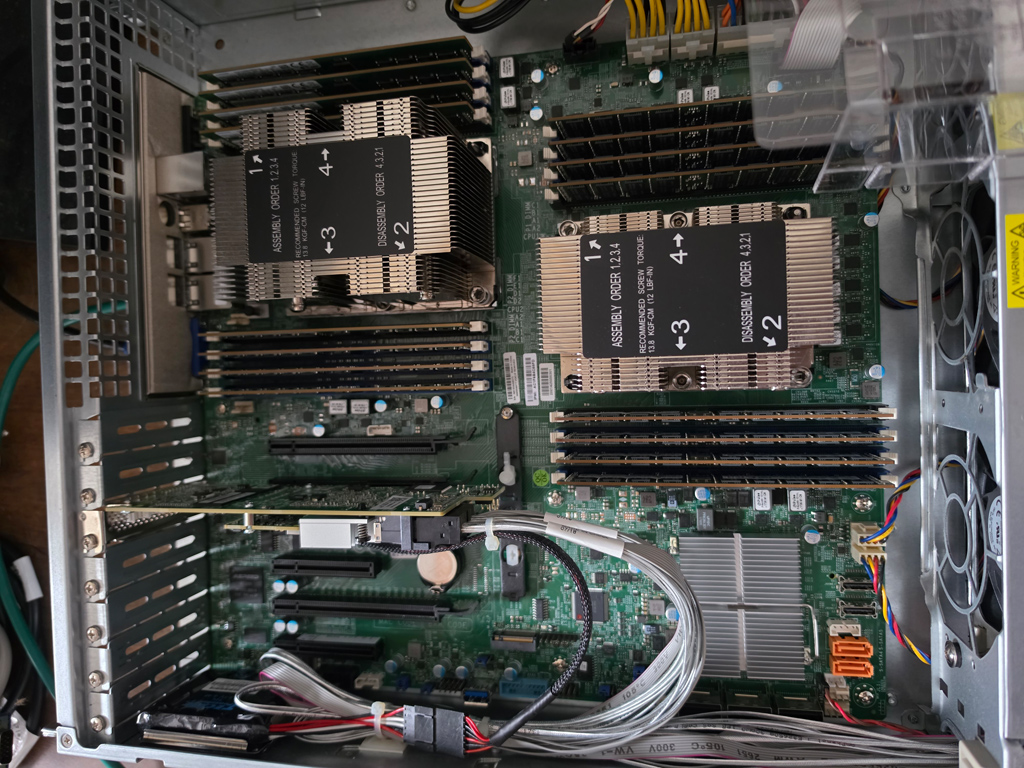
Dual-Xeon Supermicro system used for the local LLM benchmark.
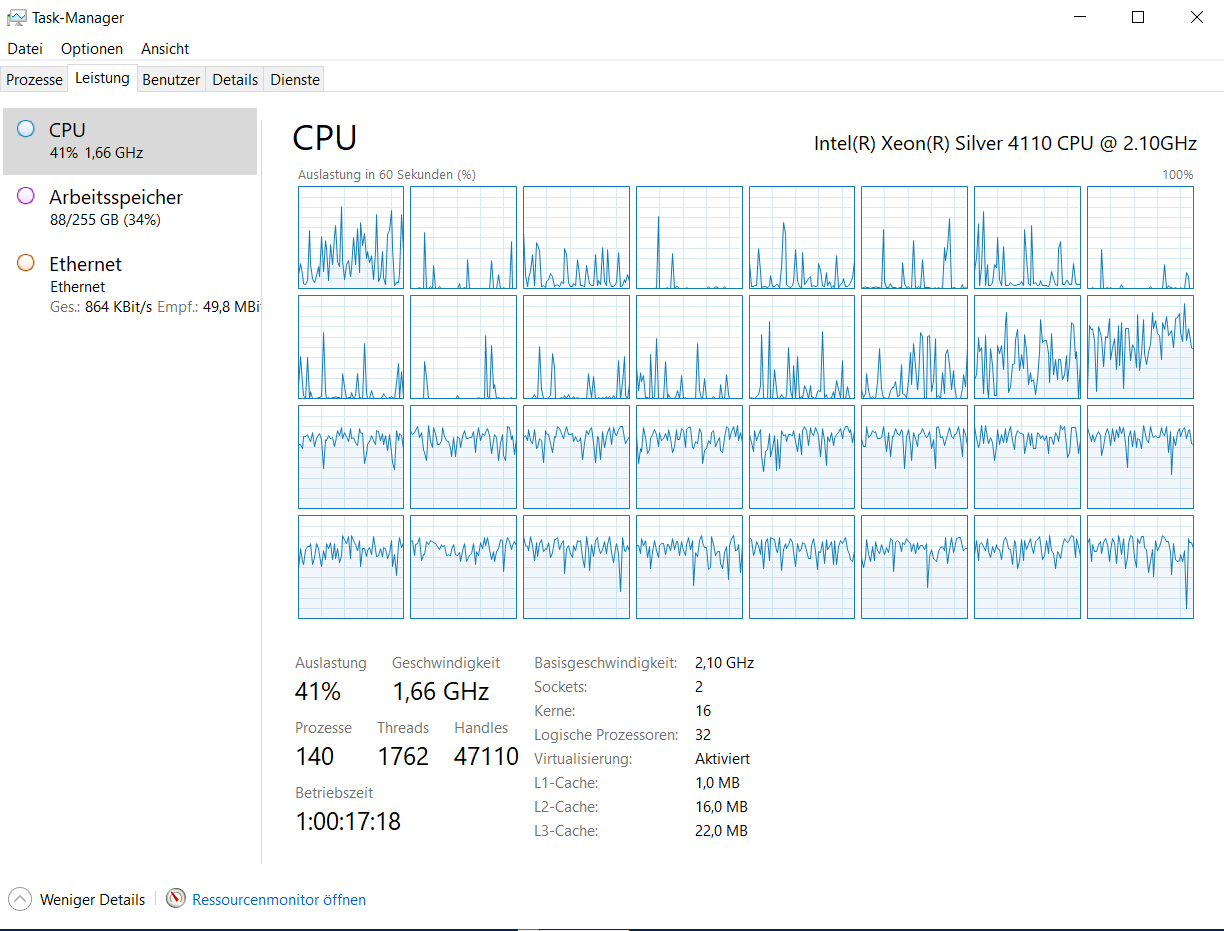
Windows CPU activity during local LLM inference.
This led to a simple engineering question: If the server is already broadcasting its operational state via sound, why not treat that sound as a telemetry stream?
The Conceptual Framework
We propose a passive observability pipeline that requires no software installation on the monitored target and no access to its management network:
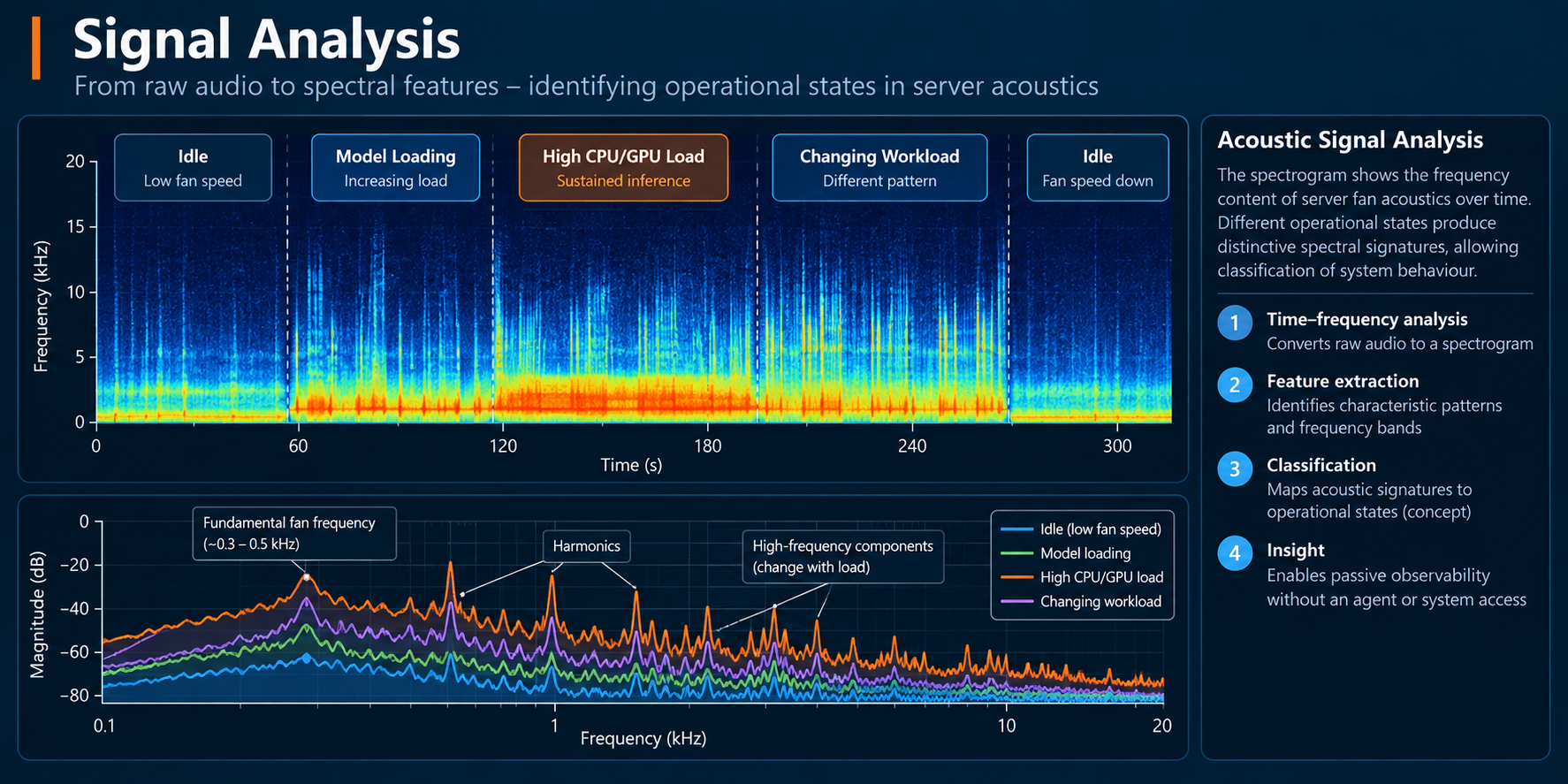
Conceptual illustration of acoustic signal analysis. The spectral data shown is illustrative, not measured benchmark data.
By applying frequency-domain analysis and monitoring spectral signatures, it is technically plausible to classify the system state based on temporal patterns in the acoustic emission.
Potential Capabilities
A sufficiently refined acoustic telemetry system could enable a range of passive monitoring capabilities:
- Workload Classification: Distinguishing between idle states and sustained CPU-intensive computational loads.
- Thermal Dynamics: Identifying characteristic fan-speed transitions and cooling behavior changes.
- Anomaly Detection: Recognizing abnormal acoustic patterns that might indicate hardware failure or suboptimal airflow.
- Air-Gapped Monitoring: Observing the operational state of systems without requiring network access or agent deployment.
In a purely speculative extension, we hypothesize that highly trained models might eventually distinguish between different classes of computational workloads—perhaps even identifying specific AI inference patterns—based solely on the resulting thermal and acoustic signature of the hardware.
Sometimes the difference between an absurd idea and an engineering prototype is one free afternoon.